22 November, 2011

A South Indian Wedding...

"Marwage is what bwings us togever today..." ~The Princess Bride

Last Friday night I witnessed my first Indian Wedding, a Hindu South Indian wedding (this one was Telugu). Indian weddings generally start at night and continue late into the night. This wedding went until about midnight, but it's common for weddings to go until the wee hours of the morning.

I tried several new foods at the wedding, I don't remember most of the names, but I really enjoyed the curry and roti served at the wedding, very good. Then there was some sort of curd, what I think was a paneer snack, rice, fruit, and sweets. An after dinner food was called 'killy' or also goes by the name 'paan'. It was a sort of crystalized sugar sweet bits wrapped in a leaf, and you actually eat the leaf! It was pretty good, it's sort of like a mouth freshener.

It was a nice wedding, and the explanations of the process helped to understand what was going on. Every part of the ceremony has a set process, with meaning and symbolism behind it. First there was the pooja, and about an hour after that the bride arrived. What surprised me right away is that throughout the entire ceremony, people were filtering in and out, staying as they chose to watch, eating when they chose, and even allowed to go up on the stage and see up close. This was very different from an American wedding where there's the ceremony that people sit quietly through (usually in a church), then afterwards have a reception with food, music, and dancing.


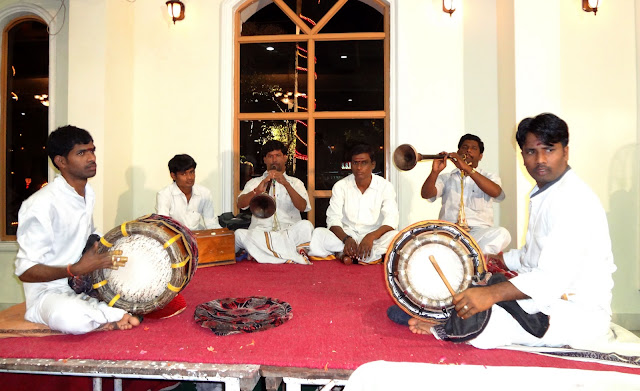
Live music was playing during the ceremony at intervals. 


 View of stage. Flowers are used everywhere in decorations in India, as in the stage decor here.


Bride and groom. Bride is in a sari, groom is in sherwani, which I have been told is the 'latest trend' for men to wear this garment. The bride here is in her first sari. In some castes, it is common practice for the bride to change saris during the ceremony. Both bride and groom have henna as well.

Bride and groom with the priest (there is a different name though that the priest is called). The priest will be speaking in sanskrit in parts, which people don't really understand the language. Bride is now in her second sari, a gift of the groom's parents.


Pooja offering. 


In America, we have the expression 'tie the knot' which is merely a figure of speech meaning to get married. However, in India there is an actual part of the ceremony where the man ties the knot of a string necklace around the woman's neck. When I first heard about the literal tying the knot part of the ceremony, I thought it was both the man and woman that tied the knot, but it's actually only the man, so that was really shocking to me that there are parts of the ceremony that only the man does when the couple marries. 


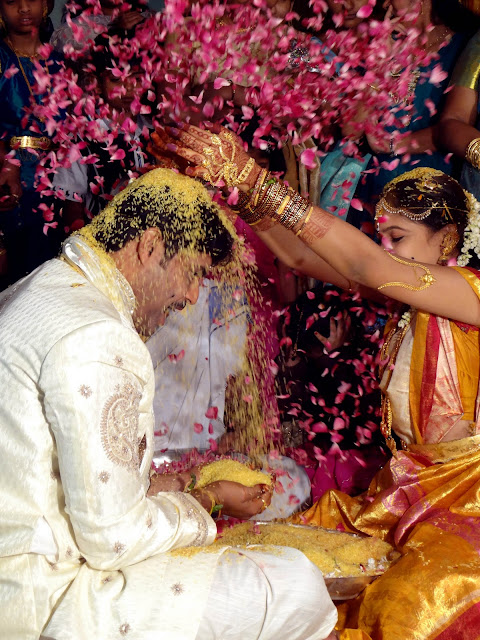
This part of the ceremony was pretty fun. The bride and groom took turns pouring the flowers and rice on each other's heads, and soon there are flower petals everywhere. This action symbolizes the couple's new freedom and relationship with each other. 


This is the last part of the ceremony, in which the bride and groom point at a star in the sky and it's supposed to symbolize two stars that are now together as one I believe, that the couple is now joined.

And that's the wedding!

14 November, 2011

Sixty Days

"I can't go back to yesterday because I was a different person then."
~Lewis Carroll, Alice in Wonderland

Before I came to India, I did my research. I read travel information online, went to a travel doctor, I watched a couple Indian movies, and I talked to anyone I knew who had been to India. But nothing I read, or saw, or heard second-hand can ever fully describe what I have experienced first-hand. Because there are intangible things that I have only been able to understand by being here, things that you can't possibly understand until you are in the situation. Nothing you learn beforehand can fully prepare you for the way your entire previous knowledge of life suddenly is flung out the window and your world is turned upside down. And then you realize that you have to view this world from upside down. It's like when a baby opens it's eyes for the first time, and at first there is so much that is new the baby doesn't really see anything at all, it is blinded by the light, but gradually it picks up more and more details, and the blinding factor wears away. This is how I feel adjusting has been, the blinding light of shock has slowly dimmed so that I can really see with new eyes this place I've been inhabiting the past two months.

When I first arrived in India, I remember being frightened to the core of my being, mostly worried about the many unknowns of this new place. What water is safe to drink? How will I get to work? What will I eat? What food is too spicy for me to eat yet that will just make me sick? What foods are even offered, I don't know the names or how they are eaten? How can I get a phone? What will I wear to work? How do the autos work? How do people learn streets when there are no street signs? What will be my new routine? etc.... My foreign experience consisted of Canada and the Bahamas, which, in my opinion, don't count. I've grown up in the Midwest where the people are "Minnesota Nice," and in the suburbs where keeping a finely manicured lawn is next to godliness and is mandatory to fit in with the neighbors (I have yet to see a lawn like that here even in the most posh areas). I remember everyone telling me I looked scared when I first arrived here and showed up for my first day of work, and I can't argue with that, it was impossible to hide the visible panic on my face as it hit me like a rock that I'm "not in Kansas anymore" (quote from the Wizard of Oz). And I remember the feeling of utter helplessness as I soon realized how very, very little I knew about the true reality of surviving in India, the land of chaos, where rules are made to be broken (such as when an auto driver just today took a "short-cut" going the wrong way on a one-way street to take me home).

One of the hardest aspects to face at times is a feeling of loneliness and homesickness when I am by myself. I have some great friends here, but still this can be hard to deal with at times. Sometimes I miss seeing familiar faces from America, and I miss American food, general cleanliness, being able to communicate with everyone without language barriers, being able to go virtually anywhere on my own without a second thought, and miss a general familiarity of life (although I'm not missing the snow). But I also know it's very natural to feel homesick in one way or another for anyone traveling for extended periods of time anywhere, and really to be expected. And then I know that there will be many things and people and experiences and food from India that I will surely miss when I go back to America, and I'm expecting to undergo some sort of reverse culture adaptation as well. And will I remember how to drive? On the right side of the road stopping at stop signs and stop lights??!

I have slowly begun to understand the chaos, though it can still be difficult as a born and raised rule follower, and the ever moving city better and it's constant flow of street traffic. India is sort of like the bloodstream of the human body. The red blood cells are constantly moving, flowing around each other in a sort of chaotic harmony. Sometimes there are issues when a blockage occurs, but for the most part, the cells, though crowded in the veins, keep flowing around each other. The trick is learning how to enter this bloodstream without causing a collision, seamlessly joining and moving and weaving in sync with the people and the traffic. Even crossing the street requires an agile weave around cars and mopeds (called bikes). I remember in elementary school learning how to jump rope. If there were two girls swinging the rope for you, it took great skill to merge into the swinging rope without getting tripped up, and jumping at exactly the right moment whenever the rope touched the ground. But once you learn the trick, that there was always a certain height the rope had to be at when you quickly jumped in, it became much easier. The main thing is to keep "Constant vigilance!" as Mad-Eye Moody would say (Harry Potter reference). I can't stress this enough for future travelers, take extreme caution on the streets, because people drive like maniacs, better safe than sorry.

I can also add, that someone mentioned I didn't include buttermilk in my list of foods I've tried, and I did forget about it, but I also really don't like buttermilk, probably one of the foods I dislike the most here. It might have something to do with the fact that the first time I tried it, I thought it was like regular cow's milk in America, and instead to my surprise it was so bitter and salty! Milk is also often served warm here if it is regular milk. Cold cereal and milk isn't common. 

Below are images of clothes that I wear to work or out and about. I feel a little weird posting this many pictures of me, but, people from back home want to see what kind of Indian clothes I'm wearing, so, here it is. I am loving my new wardrobe, but will have to be careful with what I buy or could have trouble packing for the way home....


Kurtie/Kurta and leggings. A Salwar Suit is similar, but the pants would be made of cloth instead of stretchy fabric (although I'm told you aren't really supposed to call them "pants" because they have a different name). 

 Patiala Suit (baggy pants are patiala, also called Punjabi Suit). I pieced this outfit together myself, I'm getting the hang of Indian dressing, I think, quite fun.  This is the absolute most comfortable and chic outfit I've worn so far, although leggings and kurtie is also very comfortable. Definitely going to be wearing this back home, along with the rest of the clothes I've bought here. The patiala remind me of Jasmine in Aladdin.

The scarf is called a dupatta. This is one of the "right" ways to wear it.

Because being an art student means an inability to take all normal photos. I think just for the heck of it I'll call this "Girl with a Pearl Earring Goes to India."
Original "Girl with a Pearl Earring" by Vermeer


Since jeans and a t-shirt are also very commonplace, I thought I would include a picture of typical Western Wear in India. For girls, skinny jeans and a t-shirt is common. Men wear Western wear over traditional wear more than women I think, either jeans and t-shirt or dress shirt and dress pants for work. Skinny jeans are much more practical than anything else because they don't drag on the ground, which is good because the streets are so dirty. They are also commonly worn with a kurtie/kurta top. Also, this is technically the "wrong" way to wear a scarf, because no women tie their scarfs, but for an unskilled dupatta wearer like me, I like it because it stays put better and doesn't fall off. I have also learned chappals are a type of sandal with a strap over the big toe, and sandals are called slippers.

It also occurred to me over the weekend that since all of the Indian languages have different alphabets and lettering systems, you would need a different kind of keyboard if you didn't know English. So I asked someone about it, and he said that they don't make computers with any of the Indian alphabets, so if you don't know English characters, you can't use a computer. The only option is to type something in another language using English characters, then use Google translate to translate the text to a different alphabet's characters. See how lucky native English speakers are? We don't have to learn another language just to use a computer.

I went with a friend to the Birla Mandir Temple on Sunday. It is a Hindu temple for the Lord Venkateshwara, but is named after the person who built the temple. Different statues of gods fill the temple, but unfortunately no cameras were allowed inside, so I couldn't take any close up shots of the temple itself. Before going in, it is necessary to check your shoes, mobile, and camera to enter the temple. It is a gorgeous building, made entirely of white marble, and extremely intricate and beautfiful hand carving of the stone on the facade, arches, ceilings, and on every surface of the building. Took something like 10 years to construct in the 20th century. Definitely a great place to go. The largest deity featured in the temple is Lord Venkateshwara, who people bow to as you proceed through the temple in a line. From the balcony of the temple, there is a wonderful view of Hyderabad and south side of the prominent lake Hussein Sagar. Around Hussein Sagar is the well-known Necklace Road, so named I believe because the lights around the lake form the shape of a necklace. Night is a good time to go because the temple is lit up and the weather is nice.

There are millions of gods in the Hindu religion, but there are a few that are much more common to pray to than others. Ganesh, Shiva, Venkateshwara were all featured here, and are more common. While walking through the temple, a long prayer was being read through the speakers in a rhythmic voice, which I was told was being read in Sanskrit. Sanskrit isn't actually spoken anymore, it's like Latin, so this kind of reminded me of how Catholic Mass used to be held only in Latin until the 1960s even though no one speaks the language. It was kind of funny because there was one wall with some scripture featuring a few different world religions, and my friend asked me if it was in English, and I just had to laugh because it was English from the 1600s, from the King James version of the Bible. "As ye doest..." etc, which I'm fairly certain a large majority of native English speakers don't understand, so a fairly reasonable question.
Front entrance of the Birla Temple (unfortunately hard to get a good shot of temple itself because of no camera rule to enter)


Full View of Birla Mandir Temple. What is lit up is the temple behind with a greenish tint.


Once again, thanks for reading.


"It is impossible to live without failing at something, unless you live so cautiously that you might as well not have lived at all - in which case, you fail by default." ~J.K. Rowling


09 November, 2011

Haikus - Or - Brevity and Banality

"Don't use seven words when four will do."
~Ocean's Eleven

"Brevity is the soul of wit."
~William Shakespeare

I have been getting numerous complaints that I haven't been blogging enough lately. But I only have so many earth shattering, ground breaking epiphanies to share you know! I really do enjoy blogging, but it does take a good deal of thought and time to actually create a post of substance, interest, and moderately well chosen language. Hopefully I have succeeded with my readers on at least one of these levels. Please consider this my plea of quality over quantity. And at this point you're probably thinking, "Wow, does she have anything to say today? Hurry up, you quoted brevity and this is the longest rant about nothing I've ever read! I think she keeps filling up space just for the heck of it! Oh my gosh, I think I'm right...I think I'm right."

Anyway....poor jokes aside now, as much as I can manage anyway, no guarantees....

To change up my post for today a bit, I have written a bit of poetry here I will divulge. I have a few other poems that I will try to upload later, but they are not public worthy yet, so stay tuned for those at a later date. Below are some Haikus I have written about various personal experiences in India thus far. Haikus generally have a 5-7-5 syllable line system, which is what I followed, and don't usually rhyme. They're meant to be short and, hopefully, sweet. I'm learning how to praise myself from some expert self-praisers in the office, so I will say these are unprecedentedly ingenious (HA, okay, that's a joke for those who know what I'm talking about, don't want to set expectations too high for these). At any rate, enjoy!


India Haikus

I played a new game
Called Caroms at the office
Think I 'hit it' off

Aaj, I hear "Issko!"
"Ye!" and "Kyon?!" being shouted
Caroms is intense

If I say a phrase
In Hindi to my colleagues
They go into shock

When I hear Hindi
Now I can respond wisely
"Mai samjhi naheen"

Take care on the street
And be sure to watch your feet
- Or you'll be smashed

One night a lizard
Was crawling on my wall and
It is not my pet

If you think my jokes
Are bad - they are nothing to
PJ's here - I swear

One day it was wet
I wore yellow leggings out
That was a mistake

Are you tired of my
Haikus yet? Are you? Are you?
This is the last one

*For non-Hindi speakers, any of the words that you don't recognize are Hindi. If you're curious look 'em up! :)


Simply a list of all the foods and sweets (mithai) I can name at the moment that I've tried:
Chapati (home made tortillas), Rice, Dhal, Aloo Paratha (Potato Paratha), Gobhi Paratha (Cauliflower Paratha), Samosa, Curd (sort of like yogurt), Curry, Kadai Paneer, Dosa, Idli, Lassie (dairy yogurt like sweet drink), Gulab Jamoon (sort of like doughnuts in syrup), Lady's Fingers (actually a vegetable used in a lot of dishes). I will definitely have to figure out how to cook some of this food when I go home!

Places I've tried that are also in America:
McDonalds (called McD's casually here), Subway, Pizza Hut, Quiznos. All have many more vegetarian options that the scanty 1 or 2 options in the US, I'm very jealous of the wide variety of veg options at all restaurants in India.


Soon I'll also post some clothing photos of what I've been wearing here. So, "Keep a weather eye on the horizon." ~Pirates of the Caribbean


Here are photos of a few food labels:
Nutrition labels in India are pretty scanty for a thoroughly nit-picky, scrutinizing American label reader like myself. This peanut butter jar is actually a fairly comprehensive Nutrition label for India. Vitamins and minerals are rarely listed, which always are on American food items, along with calories, fat, sodium, cholesterol, fiber, protein, and more. People don't really care about reading Nutrition Facts here, and don't count calories the way some Americans do, which fits with the whole "Que Sera Sera" attitude (Spanish for "Whatever Will Be Will Be" from a song). It also took me a bit to figure out the calories label, because on some foods it's not listed at all or it will be listed only as "Energy." Ohhhh, it's energy (or kcal as it can also be labeled, the same unit as the Calories that are tracked on American labels), it's good for you, it's not calories to be avoided, okay, I can dig that. 

Thums Up, a popular soda in India.

Here's a little "Where's Waldo." Can you find the nutrition facts? 

Oh, here it is! This tiny little box.

Some chocolate cookies, or cream biscuits as I believe they are called here.

And, fancy that! Chocolate is energy, too! I can get used to this (although my waistline might differ).


"There is nothing better than a friend, unless it is a friend with chocolate."
~Charles Dickens


06 November, 2011

Happenings

"There are two great days in a person's life - the day we were born and the day we discover why."
~William Barclay


Sometimes I feel like it is difficult for me to write, because I want whatever I write to be extremely good (even if it's not I try). I can compare this feeling to a quote from Elizabeth Bennet speaking about Mr. Darcy in Pride and Prejudice, that I am "unwilling to speak, unless [I] expect to say something that will amaze the whole room, and be handed down to posterity with all the eclat of a proverb." Haha, alright, so an exaggeration, but still a good comparison. Has anyone noticed I will bring up Jane Austen at every possible opportunity? 


Friday night I went out for a double birthday celebration with work colleagues at a place called F9. Another nice spot, with great outdoor seating and good food and drinks. Somehow at every out of office gathering with my coworkers singing seems to usually commence at some point, and hookah is brought out. I was even entreated to sing a bit, and for that I apologize that I'm really not a very good singer. Although, it would be fun to play a tune on my guitar if I had it here. It's nice to see people more relaxed out of the office. 


A few dessert places I have had food from are Naturals (my favorite ice cream here), Cream Stone, and The Chocolate Room. I've also had food from more American places, like Quiznos, Subway, and Pizza Hut. Although the food options at these places have much better vegetarian options than in the US I must say! There is more than one sub at Subway and Quiznos that is vegetarian (the rest in the US always have meat), which I have to say is nice for a change, and they use really good spices in them.


It's a real task trying to keep living quarters relatively bug-free here. It still grosses me out when I find bugs I've never seen before. Since I grew up in a colder climate, I would say Minnesota's bug situation is very mild compared to many places around the world. Here there are more bugs, larger bugs, grosser bugs, and then there's the lizards, too. Did I mention bugs are everywhere? 


I've had some very interesting conversations with people here about marriage. And it almost blows my mind how different the concept of marriage is in India. It's not the norm to have a love marriage, and arranged marriage is by far most typical. This is gradually starting to shift, I think love marriages are becoming more acceptable by families, but the current social norm is an arranged marriage within your own caste. The urban cities are more liberal minded in this, but I've heard situations can turn violent in rural areas if a woman marries a man below her caste without her family's permission. It is expected that by the time a girl is about 26 and a guy about 30, that their families should look for a someone for them to marry (it used to be that couples would get married much younger I've heard). It is not expected that a couple "fall in love" before they get married, but they will be able to meet several people that their parent's find and approve of, and then if they talk and like each other, then they might get married. I've heard a few stories of people who have wanted to get married to someone that their parents don't approve of, and it kind of breaks my heart that that means they can't get married, or if they do risk being cast away by their family. I think that the status of women has really become much better in India now, as it is very common for females to go on to higher education and work, and in my office there are a lot of women working. I've also heard that Hyderabad is one of the safer cities to be in India, people have told me Delhi is unfortunately not very safe. But it is also fairly common, although becoming less so, that women will not work after they are married, or not be permitted to work by their marriage contract. Here's my opinion on all this marriage business from Albus Dumbledore in Harry Potter by JK Rowling: "It matters not what someone is born, but what they grow to be!"


But I have also tried to explain that there is almost the opposite pressure in America on marriage, although I would say it's more accepted not to get married at all in the US than India. There is an expectation that people will find a perfect love marriage, and then live happily ever after. This "fairy tale" fantasy is exactly how many Americans want marriage to be. And there is still pressure from families to get married and raise a family with an acceptable partner, with similar beliefs, values, education, etc, except that it is up to you to find your own partner. But there are also fewer demands and expectations from the couple's families on the marriage. Still, I'm not sure if the US has it exactly figured out if you look at the 50 percent divorce rate or so. Everywhere you go, there are societal pressures to live a certain way, it's just that those societal pressures are different depending on the culture, although I would say the US has a little more leniency on this issue.


I also learned this weekend that up until about 15 years ago it wasn't very common for people to have a landline phone unless they were rich (remember this was before the mobile phone sprung into popularity). I was talking to someone who had never used a phone until about 8th grade (or 8th class as they say here). I really can't imagine that, as having a phone has been commonplace for everyone in America for decades. But now, basically everyone in India has a cell phone, and minutes are extremely cheap, so having a mobile is very affordable. 


Last week I visited a coworker's house that was pretty amazing, encompassing white marble, glass,  spectacular chandeliers, custom artwork, and a lift. This was one of the most amazing houses I've been in in the US or India. It was a fun girls night with a couple coworkers. First we got fed with home cooking until we were stuffed, then watched a Hindi movie called "Kaminey" (in English "The Scoundrels", I watched with the subtitles so I could understand it) which actually surprised me how good it was. I was expecting what I conceive of as a Bollywood movie with singing and dancing. This was more of an action movie with a great plot, which also had some singing and music in it. I also learned from this movie that a "crore" is 10 million. In India, the numbering system is different than in the US, and makes more sense to me once I looked up how the commas work in India's numbering. 


US: 
10,000,000 = 10 million = 1 crore
100,000 = 100 thousand = 1 lakh 

India: 

1,00,00,000 = 1 crore (100 lakhs in a crore)
1,00,000 = 1 lakh


Someone asked me if people have heard of India in the US, and really, I hope expectations about the US's global knowledge aren't that low. Yes, I believe nearly everyone in America has at least heard of India, even if they don't know much about it, I mean, the country does have the second largest population in the entire world!


Cheers for now.


"Differences of habit and language are nothing at all if our aims are identical and our hearts are open."
~Harry Potter and the Goblet of Fire, JK Rowling

29 October, 2011

What's Your Sign?

Truthfully, this post is not related in the slightest to America's cheesiest pick-up line, "What's your sign?" but it is about signs and other random photos I've taken in the city.


There are traffic rules? Who knew. 

"Clean and Green" 


Common movie advertisement posters. 

Pretty store front 

Awesome architecture. I've also seen a lot of multilingual signage, such as is written here, showing both Telugu and English writing (perhaps even Hindi or others, a little hard for me to differentiate...). 

Yummy ice cream parlor. I've been to Naturals, Cream Stone, and Chocolate Room so far, all very tasty. Naturals is my favorite of the three, their ice cream has the best flavors, so good!

 Not the most exciting national park I've ever seen, but I they did have some nice quote signs. Still nice to see a little bit of nature, I do like seeing nature.


I love that Robert Frost's poem was here. 

"I'm a peripheral visionary - I can see far into the future just way off to the side." ~Steven Wright


"'So I said to the hitchhiker, 'What do you do?' He said 'I'm a student'. I said 'a student of what?' He said he was studying journalism and photography, so I said 'that's funny, I'm actually writing a short story about a photographer who went completely insane trying to take a close up photo of the horizon.'"
~Steven Wright