Showing posts with label pictures. Show all posts

01 December, 2011

And Then I Saw A Sindhi Wedding...

"Nitwit, blubber, oddment, tweak."
~Albus Dumbledore in Harry Potter, J.K. Rowling

"I am so clever that sometimes I don't understand a single word of what I am saying."
~Oscar Wilde


 This wedding was a Sindhi Wedding, very different from the South Indian Wedding I attended earlier. It was a very classy wedding, very posh. I didn't see the actual ceremony, the couple was already married, but I came with a few coworkers for an afterwards sort of celebration. In India, weddings last several days with lots of food served.

Food tables - so nice to see ONLY vegetarian food options! Hehe, this would never happen in America...


Warm Milk - very tasty. Weddings are popular for the food served, and a great way to try a lot of new foods. Let's just say I came away stuffed, after tasting quite a few new foods and desserts... My coworkers tease me about being health conscious, and they were joking about how many calories everything had, I told them I would just rather not know for the night, the food was much more enjoyable that way. Tried naan and jilebe for the first time, as well as a few other things I can't remember the names of.


I was surprised to find a little American touch! (the caterer had Liberty in the name)

Mandrap - this is where the wedding ceremony takes place.

Pretty lady!


"A day without sunshine is like, you know, night."
~Steve Martin

29 November, 2011

Helpful Expectations

"For what is seen is temporary, but what is unseen is eternal."
~Jeri Smith-Ready, Shade

"If you limit your choices only to what seems possible or reasonable, you disconnect yourself from what you truly want, and all that is left is compromise."
~Robert Fritz

Sometimes I like to go up to the roof of the hostel for some fresh air, and just look. At night, I see the stars, and I recognize the constellation Orien's Belt that I learned many years ago from Star Lab in Elementary School. Halfway around the world in India, I still see the same stars, it's just that I see them from a different vantage point. No matter where you are in the world, you can look up at the same sky and see the same stars, and no one argues whether they are stars or not, there aren't battles over who the stars belong to. And it makes me wonder, how many things is the world convinced are different when we're looking at the same thing from a different spot on the globe? How many problems could be solved and peace reached if people took the time to understand each other, maybe realize they're just calling a star a star in another language, rather than waging war on each other over ignorance and misunderstandings and ill founded hatred. The more I get to know the people and the culture here, the more I realize, no matter where you go, people are always people. And once you learn more about the culture, and understand the people, the more you realize you have more in common than you might think. It can be frustrating encountering the numerous problems that arise in this process of understanding, but the reward is so valuable it's worth all of the language barriers and cultural differences that must be worked through to get there. Seeing a different part of the world has made me more openminded, more ready to accept new ideas, more willing to give people that are different from me a chance.

"Perhaps travel cannot prevent bigotry, but by demonstrating that all peoples cry, laugh, eat, worry, and die, it can introduce the idea that if we try and understand each other, we may even become friends."
~Maya Angelou

Last week I went to Shilpa Ramam with a friend for help with bargain shopping. It is necessary to bargain on everything in the open market, but you can get great deals on some beautiful items, cheaper than in the malls. Bargaining in a place like this is an art form. Plus they see a foreigner and they hike up their prices, so good to go with someone who knows the market. Handmade goods abound, such as clothing, shoes, jewelry, woodcarvings, artwork, and stoles.

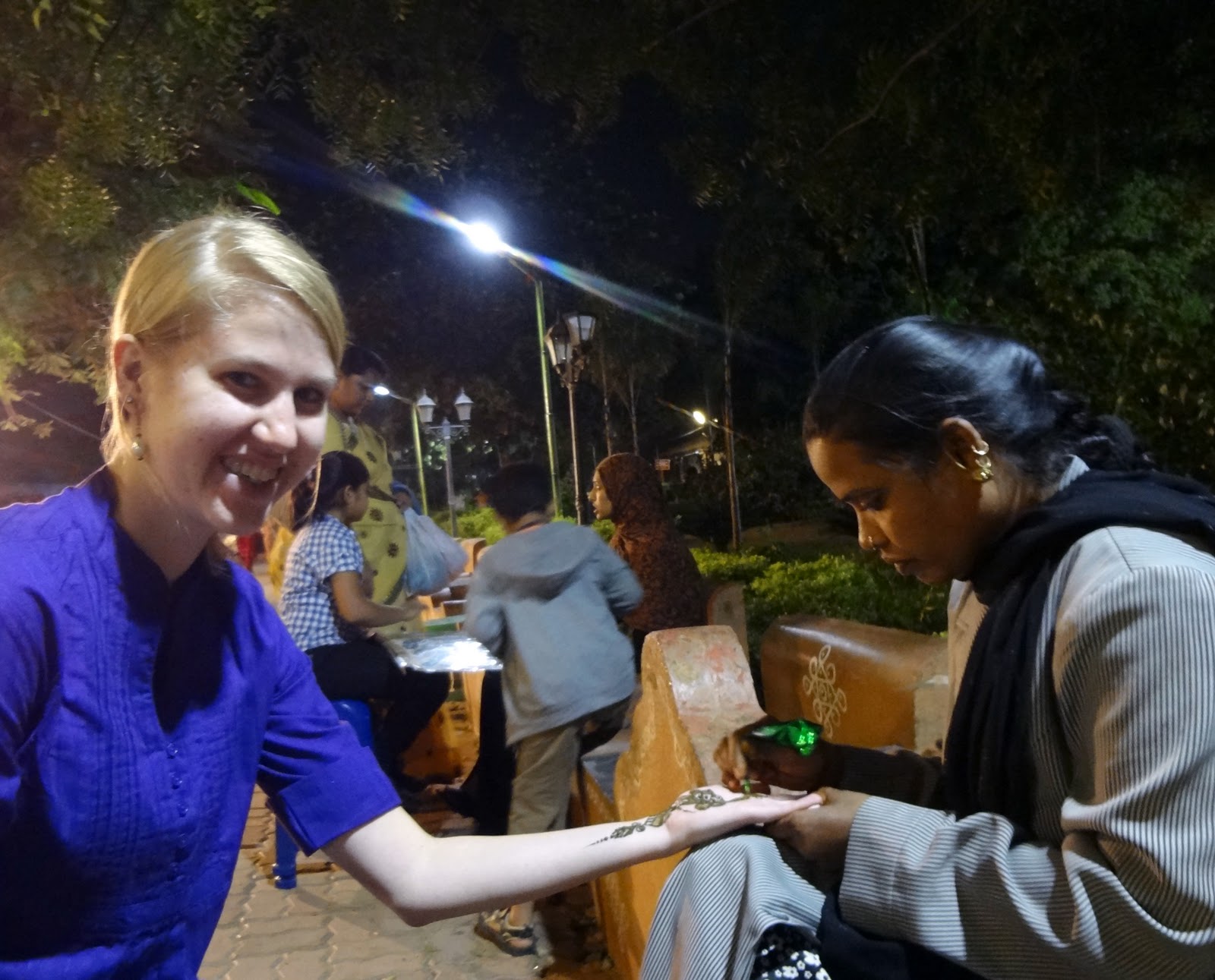
I also got Henna/Mehindi done, which is quite beautiful.

 Henna at Shilpa Ramam. Henna is like a temporary tattoo that is applied freehand in a paste. It lasts for about a week, and is a brown color. Brides will apply henna to hands and feet for weddings, or it's applied just for fun.


After the paste dries (be very careful not to smear the henna), within a few hours it will start to flake off. Then you can start scratching the rest of the excess off, and underneath the design will be a stain on your skin. The longer you leave the paste on, the darker the color when you scrape it off. 


Handmade and dyed kurtie and Henna 


Hindi me, ye harlem pants hai. (In Hindi, this is Harlem Pants) 


Eating some sort of mithai (sweet), I don't remember the name. First you squeeze out all the juice, then you eat it whole.

Below I have compiled a helpful list of things that I believe make living here easier when they are an expectation rather than a surprise.

What to Expect:
1. Expect that, as a foreigner, you will not look Indian, therefore, you will never, no matter how long you live here or adopt the clothing or the language, be treated as a native.

2. Expect to draw stares and attention wherever you go, most people are very curious to see a foreigner, or "videshi" as it's called in Hindi. More people will remember you than you will them.

3. Expect that you should always have lots of small bills on you, unless you are shopping in a mall, it's hard to get change when paying for things such as autos, parking, and street food.

4. Expect to constantly face language barriers, both verbal accent and slang as well as nonverbal body language, this is one of the reasons I have tried to learn as much Hindi as I can while living here. Even Indians face language barriers fairly frequently because of how many different tongues are spoken in the country, and each state has its own native language. In Hyderabad, and in India, there is no one language that every person speaks. The most common three in Andhra Pradesh are Telugu, English, and Hindi. The new cook in my hostel, unlike the previous who spoke Hindi, speaks only Telugu, no English or Hindi. At least before I could speak a minimal amount of Hindi to get my point across about what food I wanted, but now I can hardly communicate at all, I only know a few words in Telugu, so I mostly resort to hand signals and yes and no responses. Many other people living at the hostel that don't speak Telugu, who only speak English and Hindi or others, are having the same problem with communication. The other night one guy was attempting to speak to the cook in Hindi, she was responding in Telugu, and they kept getting louder and louder, neither of them able to get their point across, and I just had to laugh.

5. Expect to face insane traffic any time of the day or night. Take extreme caution walking on the side of the road and especially crossing streets. Crossing streets is more like "weaving" streets around traffic.

6. Expect to walk past garbage on the side of the road frequently, and expect the smell of the air to be polluted. Expect roads to be bumpy and the sides unmaintained.

7. Expect that sometimes you will find genuine people that are perfect strangers to help you out in case of communication problems, as well as people trying to rob tourists blind (such as auto drivers).

8. Expect to need to prod people often to remind them to do things. It's not annoying here, it's necessary. A day is like a week, and a week like a month.

9. Expect to feel very homesick at times, it's natural during an extended stay in a foreign country, surrounded by unfamiliar territory.

10. Expect stomach upset upon arrival when adjusting to new climate conditions and food, or if you eat something that doesn't agree with you. Always drink bottled water.

11. Expect to wear pants in 100 degree F weather.

12. Expect paperwork to be a hassle and never go smoothly, and to get a different answer depending on who you talk to.

13. Expect to see beggars on the street whenever you go outside.

14. Expect to see a juxtaposition of very rich and very poor right next to each other.

15. Expect to see wild dogs roaming the streets constantly. They're fairly harmless and inactive during the day, but just be careful around them, especially at night. I often also see cows and chickens near garbage sites.


And now, as I have begun listening to Christmas music (being post-Thanksgiving I immediately started up the holiday tunes), I'm looking forward to the holidays, to be being with friends and family. Yet I am also sad to be leaving India, leaving my home of the past 2 and a half months, leaving wonderful people and the chaos of Hyderabad, just as I'm really getting the hang of things here. I think that going to another place, observing a new culture, and meeting new people makes you reevaluate your own culture, your own home, your own beliefs. It makes you more open minded, more understanding, and I'm not really sure if I will fully realize how I've changed as a person until I go home and am surrounded by familiarity once again.


"I am only one, but still I am one. I cannot do everything, but still I can do something; and because I cannot do everything, I will not refuse to do something that I can do."
~Edward Everett Hale

"If I had to live my life again, I'd make the same mistakes, only sooner."
~Tallulah Bankhead

"I may not have gone where I intended to go, but I think I have ended up where I needed to be."
~Douglas Adams, The Long Dark Tea-Time of the Soul

22 November, 2011

'Sari' for the Pun...

"Support bacteria - they're the only culture some people have." ~Steven Wright

What a busy and wonderful weekend! I believe in Hindi I would say it was 'bindaas', fantastic. Friday night I went to my very first Indian Wedding, a Hindu South Indian Wedding. It was a friend of a friend's wedding, so I tagged along and thoroughly enjoyed the new experience. This I will show in my next blog post to compile the pictures of the ceremony.
Saturday I went to a few other shops I had yet to visit, City Center and Westside, going with a colleague. Browsed selections of kurties, suits (these are dress like items in India, versus the American suit term as meaning a jacket and trousers). I learned from this friend that the term 'vest' in India means a white undershirt. I had pointed to an item that was button up and sleeveless that you wear on the outside of a dress shirt and said it was a nice vest, an American term apparently, and she started laughing and asked me if I called that a vest. Additionally, I mentioned that Americans will call speaking Spanish mixed with English 'Spanglish,' and apparently in India there is something called 'Hinglish,' a mix of English and Hindi. However, the lesser known 'Spindi', is a mix of Spanish and Hindi, which I believe is a VERY recent development in the Indian lingual system (hint hint...). In this type of language, people say things like 'Hola yaar!' and 'Como estas yaar?' and 'Kyaa hal hai, amigo/a?'

Saturday night went with a friend to Shilpa Ramam, a center to preserve traditional Telugu arts and crafts, culture and language. I saw traditional Telugu dance for the first time, unfortunately I don't have pictures, but the women were dressed in clothing styles of several hundred years ago. Brightly colored silks and fabrics, henna, jewelry, and stage make-up. I was told that it takes many years to learn this kind of dance, because it is very difficult, and every movement of the body and facial expression means something. Then I saw some traditional hand crafted goods, wood carvings, art, small statues of gods, jewelry, etc. There were some nice paths to walk around at the place, and I really love weather here at night. Everyone keeps saying how cold it's getting, but I personally think it's perfect weather, pretty similar to Minnesota weather at night in the summer. Also, because it's not the monsoon season anymore, the weather is much drier.

Sunday I wore a sari for the first time. I borrowed it and had help wrapping it by the auntie at my hostel. It's quite a difficult garment to wear, every movement is a very conscious one with all of the folds of fabric. It takes practice to walk and carry it. The sari I wore was a very elegant one, and is featured below. I wore this for a lunch outing at a community gathering sort of event.

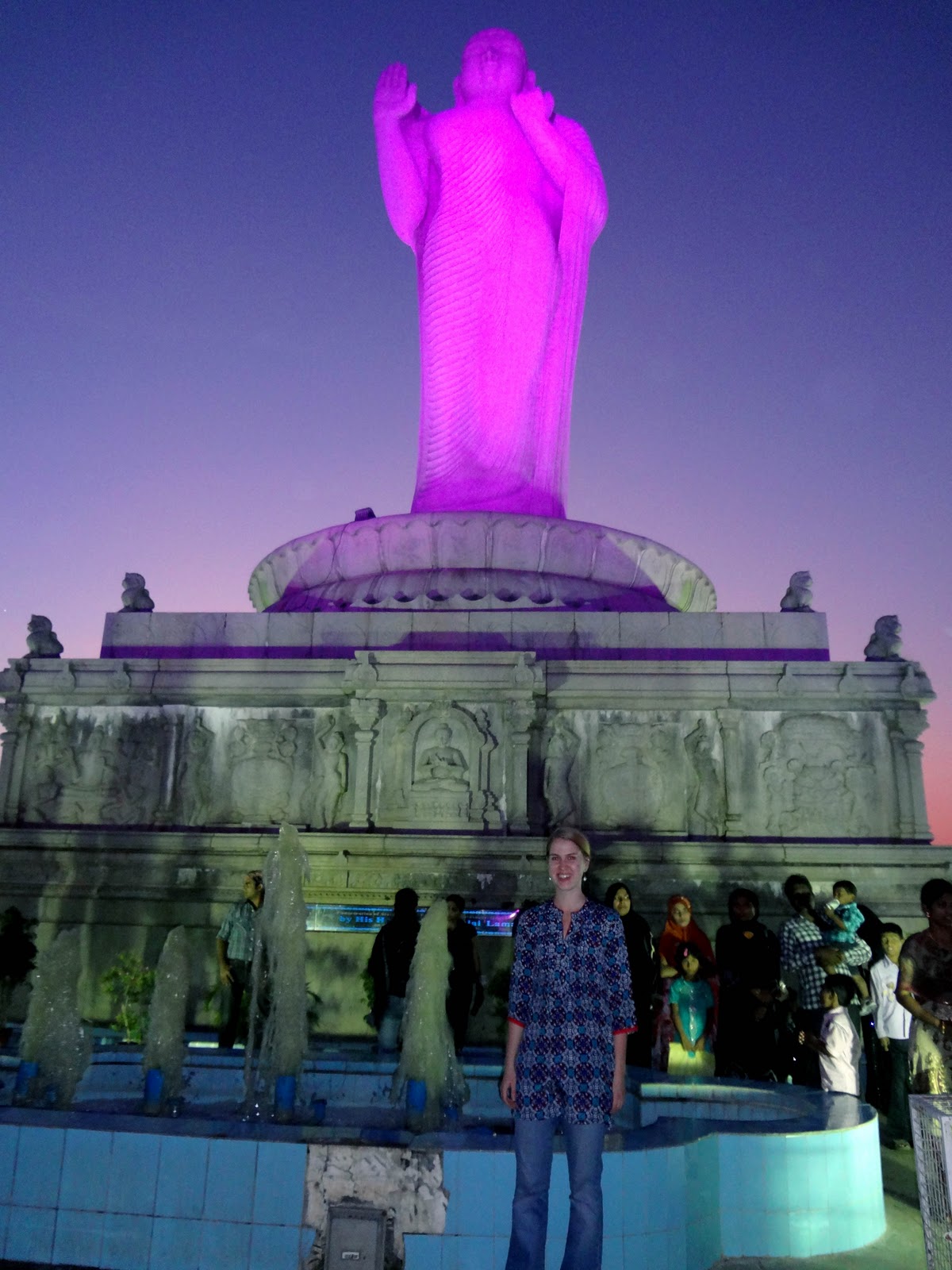
Sunday night took my first boat ride with a friend on the lake Hussain Sagar to the Buddha statue in the middle of the lake, also featured below.

First experience in a sari. It is a very elegant feeling wearing a sari, but also takes a good deal of skill to make any sort of movement.

Process of tying the sari, with help from the Auntie.

Just another pic of very typical day to day Indian wear. 


My new 'slippers,' or sandals as they would be called in America.

This bike is how I've been getting to and from work. I like to think I'm just a little bit badass. 

This outfit I wore to the wedding with a dupatta (not shown here). It is a patiala suit, and I believe this style of patiala is also called harlem, to be worn with a kurtie/kurta.


View of Hussain Sagar shore from the boat. The road around the lake is called Necklace Road because from above the lights around the lake resemble a necklace.

View of Birla Mandir Temple from Buddha Statue on Hussain Sagar.


In front of the 17 meter high Buddha Statue. It is the largest monolithic statute of Gautam Buddha in India, carved out of a SINGLE slab of granite rock by 40 sculptors. The lights on it rotate colors, very pretty to observe at night.


Theek hai, that's a 'wrap'! You, know, because of the whole sari thing and all...


P.S. *Disclaimer #1: No, I don't actually drive a bike to work...yet :)
**Disclaimer #2: I have personally coined the phrase 'Spindi,' which is not actually an international term yet, but I believe will catch on very rapidly in the near future, as I am currently promoting the use of the slang.


"You cannot find peace by avoiding life."
~Virginia Woolf


A South Indian Wedding...

"Marwage is what bwings us togever today..." ~The Princess Bride

Last Friday night I witnessed my first Indian Wedding, a Hindu South Indian wedding (this one was Telugu). Indian weddings generally start at night and continue late into the night. This wedding went until about midnight, but it's common for weddings to go until the wee hours of the morning.

I tried several new foods at the wedding, I don't remember most of the names, but I really enjoyed the curry and roti served at the wedding, very good. Then there was some sort of curd, what I think was a paneer snack, rice, fruit, and sweets. An after dinner food was called 'killy' or also goes by the name 'paan'. It was a sort of crystalized sugar sweet bits wrapped in a leaf, and you actually eat the leaf! It was pretty good, it's sort of like a mouth freshener.

It was a nice wedding, and the explanations of the process helped to understand what was going on. Every part of the ceremony has a set process, with meaning and symbolism behind it. First there was the pooja, and about an hour after that the bride arrived. What surprised me right away is that throughout the entire ceremony, people were filtering in and out, staying as they chose to watch, eating when they chose, and even allowed to go up on the stage and see up close. This was very different from an American wedding where there's the ceremony that people sit quietly through (usually in a church), then afterwards have a reception with food, music, and dancing.


Live music was playing during the ceremony at intervals. 


 View of stage. Flowers are used everywhere in decorations in India, as in the stage decor here.


Bride and groom. Bride is in a sari, groom is in sherwani, which I have been told is the 'latest trend' for men to wear this garment. The bride here is in her first sari. In some castes, it is common practice for the bride to change saris during the ceremony. Both bride and groom have henna as well.

Bride and groom with the priest (there is a different name though that the priest is called). The priest will be speaking in sanskrit in parts, which people don't really understand the language. Bride is now in her second sari, a gift of the groom's parents.


Pooja offering. 


In America, we have the expression 'tie the knot' which is merely a figure of speech meaning to get married. However, in India there is an actual part of the ceremony where the man ties the knot of a string necklace around the woman's neck. When I first heard about the literal tying the knot part of the ceremony, I thought it was both the man and woman that tied the knot, but it's actually only the man, so that was really shocking to me that there are parts of the ceremony that only the man does when the couple marries. 


This part of the ceremony was pretty fun. The bride and groom took turns pouring the flowers and rice on each other's heads, and soon there are flower petals everywhere. This action symbolizes the couple's new freedom and relationship with each other. 


This is the last part of the ceremony, in which the bride and groom point at a star in the sky and it's supposed to symbolize two stars that are now together as one I believe, that the couple is now joined.

And that's the wedding!