Showing posts with label telugu. Show all posts

22 November, 2011

A South Indian Wedding...

"Marwage is what bwings us togever today..." ~The Princess Bride

Last Friday night I witnessed my first Indian Wedding, a Hindu South Indian wedding (this one was Telugu). Indian weddings generally start at night and continue late into the night. This wedding went until about midnight, but it's common for weddings to go until the wee hours of the morning.

I tried several new foods at the wedding, I don't remember most of the names, but I really enjoyed the curry and roti served at the wedding, very good. Then there was some sort of curd, what I think was a paneer snack, rice, fruit, and sweets. An after dinner food was called 'killy' or also goes by the name 'paan'. It was a sort of crystalized sugar sweet bits wrapped in a leaf, and you actually eat the leaf! It was pretty good, it's sort of like a mouth freshener.

It was a nice wedding, and the explanations of the process helped to understand what was going on. Every part of the ceremony has a set process, with meaning and symbolism behind it. First there was the pooja, and about an hour after that the bride arrived. What surprised me right away is that throughout the entire ceremony, people were filtering in and out, staying as they chose to watch, eating when they chose, and even allowed to go up on the stage and see up close. This was very different from an American wedding where there's the ceremony that people sit quietly through (usually in a church), then afterwards have a reception with food, music, and dancing.


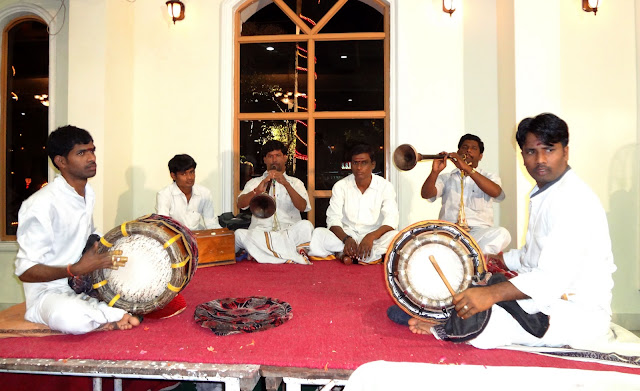
Live music was playing during the ceremony at intervals. 


 View of stage. Flowers are used everywhere in decorations in India, as in the stage decor here.


Bride and groom. Bride is in a sari, groom is in sherwani, which I have been told is the 'latest trend' for men to wear this garment. The bride here is in her first sari. In some castes, it is common practice for the bride to change saris during the ceremony. Both bride and groom have henna as well.

Bride and groom with the priest (there is a different name though that the priest is called). The priest will be speaking in sanskrit in parts, which people don't really understand the language. Bride is now in her second sari, a gift of the groom's parents.


Pooja offering. 


In America, we have the expression 'tie the knot' which is merely a figure of speech meaning to get married. However, in India there is an actual part of the ceremony where the man ties the knot of a string necklace around the woman's neck. When I first heard about the literal tying the knot part of the ceremony, I thought it was both the man and woman that tied the knot, but it's actually only the man, so that was really shocking to me that there are parts of the ceremony that only the man does when the couple marries. 


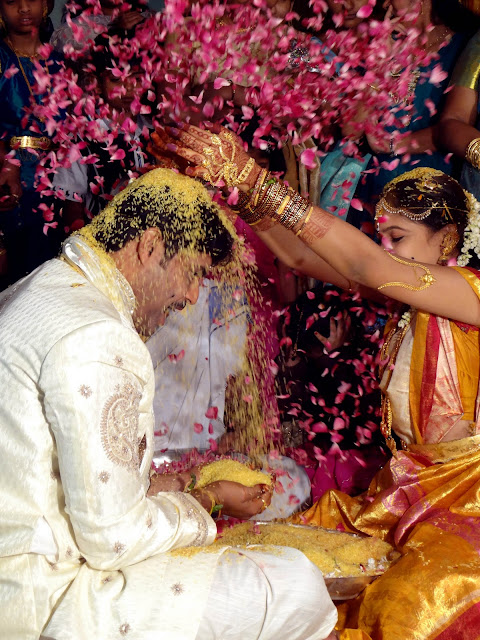
This part of the ceremony was pretty fun. The bride and groom took turns pouring the flowers and rice on each other's heads, and soon there are flower petals everywhere. This action symbolizes the couple's new freedom and relationship with each other. 


This is the last part of the ceremony, in which the bride and groom point at a star in the sky and it's supposed to symbolize two stars that are now together as one I believe, that the couple is now joined.

And that's the wedding!

29 October, 2011

What's Your Sign?

Truthfully, this post is not related in the slightest to America's cheesiest pick-up line, "What's your sign?" but it is about signs and other random photos I've taken in the city.


There are traffic rules? Who knew. 

"Clean and Green" 


Common movie advertisement posters. 

Pretty store front 

Awesome architecture. I've also seen a lot of multilingual signage, such as is written here, showing both Telugu and English writing (perhaps even Hindi or others, a little hard for me to differentiate...). 

Yummy ice cream parlor. I've been to Naturals, Cream Stone, and Chocolate Room so far, all very tasty. Naturals is my favorite of the three, their ice cream has the best flavors, so good!

 Not the most exciting national park I've ever seen, but I they did have some nice quote signs. Still nice to see a little bit of nature, I do like seeing nature.


I love that Robert Frost's poem was here. 

"I'm a peripheral visionary - I can see far into the future just way off to the side." ~Steven Wright


"'So I said to the hitchhiker, 'What do you do?' He said 'I'm a student'. I said 'a student of what?' He said he was studying journalism and photography, so I said 'that's funny, I'm actually writing a short story about a photographer who went completely insane trying to take a close up photo of the horizon.'"
~Steven Wright

25 September, 2011

Telugu, Hindi, and Lady Gaga

While I am at work, I can expect a mix of music including Telugu, Hindi, and popular American pop and hard rock songs, I like hearing what kind of Telugu and Hindi music people listen to here even though I don't understand the lyrics. I've heard Lady Gaga a few times at work, and many people here seem to also really like Enrique Iglesias, Rihanna, and Eminem. May I venture to recommend a few of my favorite artists? Regina Spektor, MGMT, Simon and Garfunkle, seriously people of India, you won't regret it!

Many people from the US may have heard of Bollywood (Hindi language film industry based in Mumbai/Bombay), a play on word from Hollywood, but I found it interesting that the name of the Telugu film industry is called Tollywood. Yep, I thought it was kind of funny. Apparently Telugu movies are sometimes filmed in some of the mansions of Jubilee Hills. Indian movies are very dramatic, it seems they all need to have everything: action, suspense, romance, sentiment, mystery, music, etc...

I'm also finding it very easy to fit in as a vegetarian. A much larger percentage of the population is vegetarian in Indian than in America, so it's not difficult at all for me to find vegetarian food options. "Ek plate Aloo Paratha lana" is Hindi for "one plate of Aloo Paratha" which I learned to order my lunch at work.

A couple co-workers taught me more slang term's for "pj's." In a previous blog I wrote about pj's being "poor jokes," but I have since learned that "pj's" can also be "puranna jokes" and "paapi jokes," which all mean poor jokes.

I was speaking with a female co-worker who is engaged and I was asking about the wedding preparations. When I asked about a "Bachelorette Party," she said she hadn't heard the term, but she called it a "Spinster's Party." Someone else I asked had heard of it, but said it wasn't as common in India.

Right now the Telangana strike (for separate statehood) is going on in Hyderabad and the buses have been shut down since Tuesday and autos since Friday. There has also been a mandated power outage for 2 hours each day in the city for the last few days as well, because of the strike there has been a shortage in coal. The regular shutdowns of power is something I have never experienced until coming to India.

Americans on average speak one language, with some knowledge of a second language. Indians on average speak at least three, some of my co-workers speak more because there are so many languages spoken in India, each with their own separate alphabet as well. Many people here just pick up languages for fun, almost as a hobby. First people will have their mother tongue, then they will learn English and then probably Hindi, and then they will pick up other languages depending on if they travel to other parts of India or if they have family or friends in other areas, or just because. I am finding in Hyderabad many people mix in languages together, that they hold a conversation in bits and pieces of various languages. Generally people in the northern part of India will all speak Hindi, and people in the southern part will speak whatever the official state language is. But in the business world everyone needs to know English. I think that America and India are both diverse places but in different ways.

Friday night I went out for an evening with some of my colleagues to a place called News Cafe. The outdoor view was quite beautiful, and it was nice to relax out of the office. There was a mix of some Indian style dishes and American food. The Chili Paneer I had was excellent. I have been to a few mall areas now in Hyderabad, including Central, Big Bazaar, and Inorbit (Inorbit is located in Hi-tech city where all the major software companies are located in Hyderabad). Apparently Inorbit is one of the largest malls in Southern Asia. The large shopping malls are actually very similar to shopping malls in America, except I have noticed there is a lot more security in Hyderabad shopping stores. Before entering every mall I have to go through a metal detector where a security guard is monitoring, and I often see more security guards around. I have also had to check-in my shopping bags before I enter another store.

I got a tip to buy something called called "All-Out" which helps with bugs in my room, it is kind of like a Glade Plug-in in the outlet, except it helps keep the bugs away.

Okay, I know I keep mentioning driving here, but I wanted to comment about the honking again, because, as I told a few coworkers, I have been driving for six years in the US, and I don't ever recall honking while driving, because it's just not really a common thing. In India, people will keep honking while they are driving all the time, basically to let everyone around them know where they are. When asking people about it, I have been told that it is because there is no confidence in other drivers here like in other parts of the world. In the US, there is confidence that everyone will stop at a red light, or that you can go at a green light. But in India, there is no confidence in what the other drivers will do, so everyone honks all the time as a signal. The best comparison I have reached has to do with bats and "echolocation." When bats fly, they emit high pitched sounds as sound waves which bounce off objects the sound wave comes into contact with. When they emit this sound wave, they listen for the echos and process the returning information, thus they can then determine from that how far away objects are depending on how long it takes a noise to return. And so, when people drive in India, they honk at each other and listen for other cars honking to know where the other drivers are. Alright, well, maybe it's kind of silly, but I think it's a pretty good comparison anyway!

Additionally, there are no visible street names on the roads to find your way around. In the US, roads are clearly marked with street signs all over and this is by far the best method of giving directions. In India there are road names but no way to see what they are when you are driving because all the roads are unmarked. When people get around they mostly just go by landmarks and names of buildings instead unless they already know what the names of streets are.


Yes, Indians like Google, too! (Except it's google.co.in instead of google.com)